Feature-News
Frozen Witness: The Silent Story of Green Boots on Everest
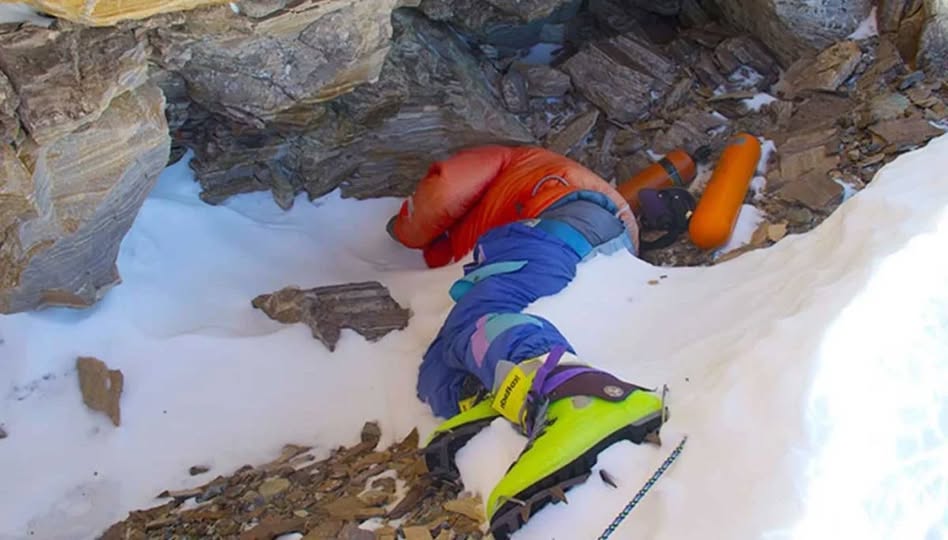
High on the northeast ridge of Mount Everest, where the air thins into something barely fit for life and the sky feels close enough to touch, lies a man the world knows not by his name, but by his boots.
They are bright green, or at least they once were. Neon against the endless white. A small, almost human splash of color in a place that strips everything down to bone and breath. For decades, climbers passing through a shallow limestone cave at over 8,500 meters have used him as a landmark. Turn left at Green Boots. A direction. A reference point. A grim reassurance that they are on the right path.
And that is the quiet horror of it.
Green Boots is believed to be an Indian climber who perished during the disastrous 1996 Everest storm, though the mountain has never confirmed this, and perhaps never will. Up there, names dissolve. Passports freeze. Stories are buried under snow and retold only in fragments. What remains is the body—preserved by cold so absolute it stops decay—and the boots that refuse to fade.
He sits curled in that cave, as if sleeping, as if sheltering from the wind for just a moment longer. Climbers who see him often describe a strange mix of fear, sorrow, and gratitude. Fear, because he is proof of how small a human life is against Everest. Sorrow, because he was once someone with dreams, loved ones, a reason to climb. Gratitude, because his presence tells them where they are—and warns them of what could happen if they stay too long.
No one stops to mourn. They cannot. At that altitude, compassion competes with survival. Every step is a negotiation with death. To pause too long is to join him.
And yet, Green Boots is never truly passed by.
He is seen in photographs, whispered about in tents, etched into the collective memory of mountaineering. Some climbers say they avoid looking at him. Others say they always do, unable not to. In his stillness, he asks a question no one can answer easily: What is the cost of standing on top of the world?
Everest is often romanticized as conquest, triumph, glory. But Green Boots tells a different story—one without a summit photo, without applause. He reminds us that the mountain does not care about ambition or courage. It does not distinguish between legends and first-timers. It simply waits.
In recent years, his body has reportedly been moved or covered, perhaps out of respect, perhaps to spare future climbers the sight. But Green Boots has already done what most of us will never do: he has become part of Everest itself.
Not a hero carved into stone.
Not a villain undone by hubris.
But a silent witness.
And as long as people chase the sky, as long as boots crunch into snow above the clouds, the story of Green Boots will remain—frozen in time, asking us to remember that every dream has a human shape, and every mountain keeps its own dead.