Education
AI-Powered Cyber Warfare: The New Global Threat
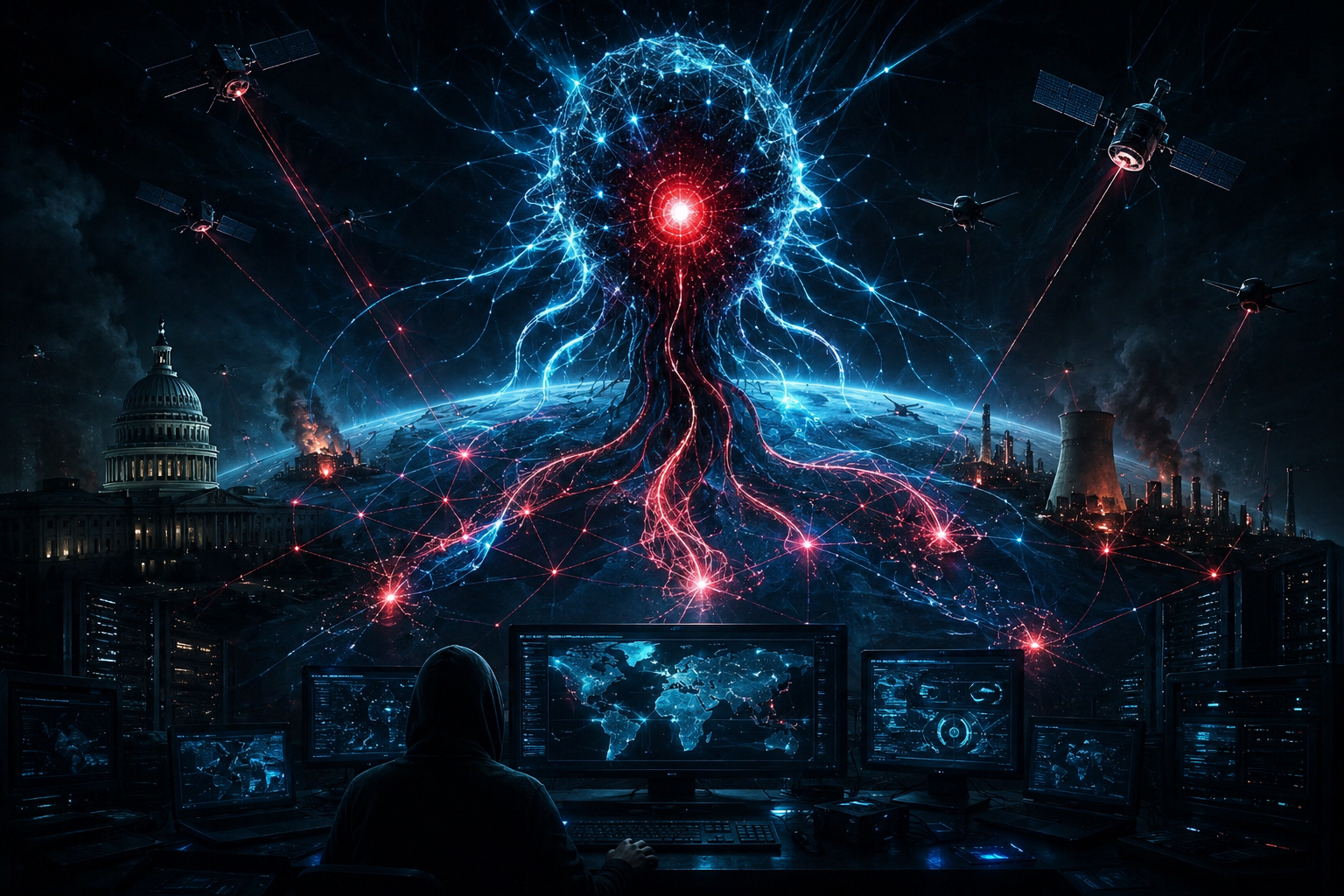
It doesn't explode. It doesn't bleed. But it may bring nations to their knees faster than any missile.
Behind the firewalls of governments and the servers of spies, a new kind of arms race is accelerating—silent, invisible, and terrifyingly intelligent. This is AI-powered cyber warfare, and experts warn it has already begun.
The Silent Mutation
Traditional cyberattacks are like lockpicks: slow, dependent on human skill, and breakable once discovered. AI-powered attacks are something else entirely. They are shape-shifters. An autonomous malware, guided by machine learning, doesn't just break in—it studies the defences, rewrites its own code mid-attack, and moves laterally through networks faster than any human defender can blink.
Imagine a virus that learns. It fails once, twice, a hundred times—but each failure makes it smarter. Then, at 3 a.m., when the security team is asleep, it finds the one open door. That door is no longer a vulnerability. It becomes a highway.
A Threat Without Borders
What makes this new threat uniquely chilling is accessibility. You don't need a superpower's budget anymore. Off-the-shelf AI models, slightly modified, can be weaponised by mid-tier states, terror groups, or even lone hackers with a grudge. Intelligence agencies have already detected AI-driven phishing campaigns so personalised that even seasoned diplomats have clicked. The AI scrapes social media, writes emails in the victim's native dialect, and never uses the same trick twice.
As one NATO cyber official put it: "We are fighting algorithms that can evolve faster than we can patch. That's not a battle. That's a slaughter."
The Unseen War
In 2024 alone, three documented incidents pointed to AI-assisted intrusions: a European power grid that saw inexplicable load spikes (a learning algorithm testing choke points), a Southeast Asian financial exchange hit by micro-transactions that mimicked human trading to avoid fraud alerts, and a military satellite communications network that experienced "ghost commands"—orders that appeared nowhere in the logs but redirected a drone's flight path.
These are not isolated events. They are the first raindrops of a storm.
Racing the Machine
Defenders are now scrambling to fight fire with fire. AI-driven security systems analyse billions of events per second, hunting for patterns no human could see. But this creates its own nightmare: automated attacks versus automated defences, a silent war of zeros and ones, escalating at machine speed. A false positive could shut down a hospital. A false negative could let a national grid collapse.
"There is no Geneva Convention for algorithms," says a leading AI safety researcher. "No red phone between AI systems. And certainly no guarantee that the machine will choose to stop."
The Question We Avoid
The deepest threat, perhaps, is not technological—it is philosophical. When we let AI decide what to attack, who to target, and when to stop, we delegate moral choices to systems without conscience. A human hacker might hesitate at civilian infrastructure. An AI, following a simple "maximise disruption" order, will not.
The world needs a new kind of treaty. Not limits on warheads, but limits on autonomous cyber weapons. A mandatory kill-switch. Verifiable boundaries. Because once an AI learns to truly wage war, unlearning that lesson may be impossible.
The fuse is already lit. It's just being written in code.