Feature-News
"The Red Carpet Deal"
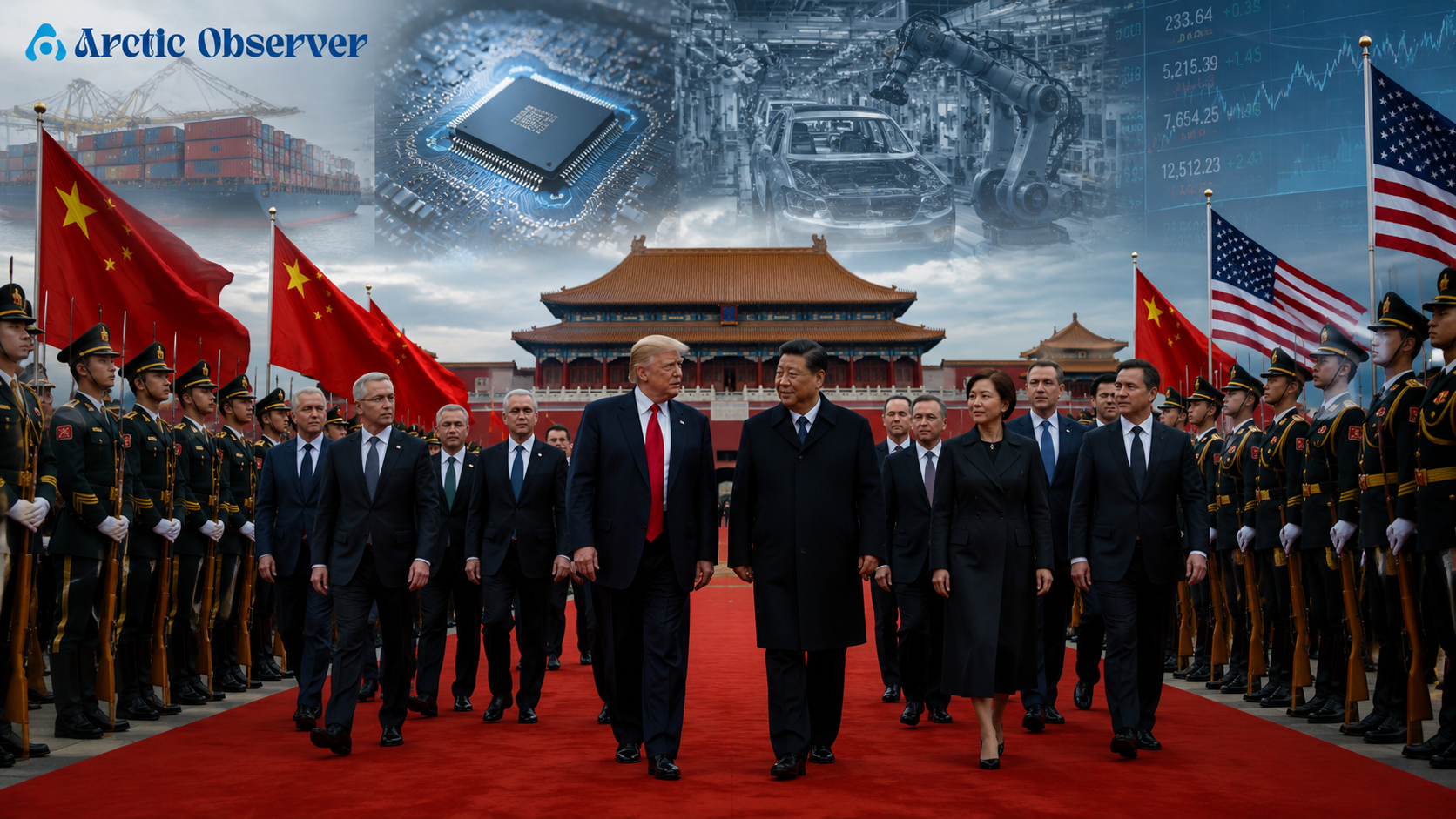
The choreography started before Air Force One's wheels stopped in Beijing.
On the tarmac a red carpet was already laid out. A military band waited. Rows of schoolchildren stood in the cold, waving a small American flag in one hand and a Chinese flag in the other. Cameras were rolling.
Then the door opened and Donald Trump walked out. He was not alone. Right behind him came a line of men you almost never see on the same plane.
Elon Musk, coat pulled tight. Jensen Huang from Nvidia, whose chips sit at the center of the tech cold war. Tim Cook, scanning the crowd the way he scans a factory floor. Behind them, the heads of BlackRock, Goldman Sachs, Boeing, Qualcomm, and Micron.
It did not look like diplomacy. It looked like a boardroom that had borrowed a country for a backdrop.
Why China rolled it out
For Beijing this was theater with a purpose. After years of wolf warrior headlines and tighter rules for foreign firms, Xi Jinping needed a different picture.
The red carpet, the flags, the handshakes — the audience was not Washington. It was investors in New York, Berlin, and Taipei. The message was clear. We are still open for business, but only for the businesses we choose.
Hospitality was leverage.
Why Trump brought the CEOs
Trump loves a visual, and this was his favorite kind. Stand in the middle, CEOs behind you, and tell a simple story.
Buy more American products. Open your markets wider. Let our companies compete. In return, maybe we ease the pressure.
Having Musk, Cook, and Huang standing there did the talking for him. It let him be tough on China in speeches back home, and transactional with China on the runway.
What each CEO was really carrying
Behind the smiles, they all had a problem.
Huang has watched Washington block his most advanced AI chips from China. The H20 restrictions alone cost Nvidia billions in projected sales. Yet he cannot leave, because Chinese data centers remain one of his biggest markets. He was there because his company lives exactly where geopolitics meets profit.
Musk's problem is physical. China is not just a market for Tesla. It is the factory. The Shanghai plant builds roughly half of all Teslas. One bad regulatory meeting can erase a quarter's output. He shook hands because he has to protect the line.
Cook has been making this trip for ten years. Apple still builds most iPhones in China and still sells millions of them to Chinese consumers. For him this was not a summit. It was maintenance.
The bankers came for a different door. Citi, Blackstone, Goldman Sachs want deeper access to China's financial system. Visa and Mastercard want ordinary Chinese shoppers to swipe without friction. They were not there for photos. They were there for licenses.
The contradiction no one could fix
While the band played, the trade war kept running.
Washington still blocks advanced semiconductors. Beijing still limits rare earth exports and builds its own supply chains to replace American ones. Both capitals talk about decoupling on television, while their biggest companies grow more tangled every quarter.
Trump talked about "hundreds of billions" in new Chinese investment into American tech. Whether that money appears is uncertain. The headline was the point.
That is the paradox of the modern economy. The two superpowers are competing for dominance while remaining financially intertwined.
China knows those CEOs will fly home and lobby against the next round of tariffs. They will warn Washington that a full break costs jobs and revenue. In that way, American business leaders become Beijing's most effective unofficial diplomats.
And the CEOs know the job has changed. They used to follow foreign policy. Now, just by showing up on a red carpet, they help shape it.