Feature-News
"Soil and Saga: The Ship Sailed to Valhalla"
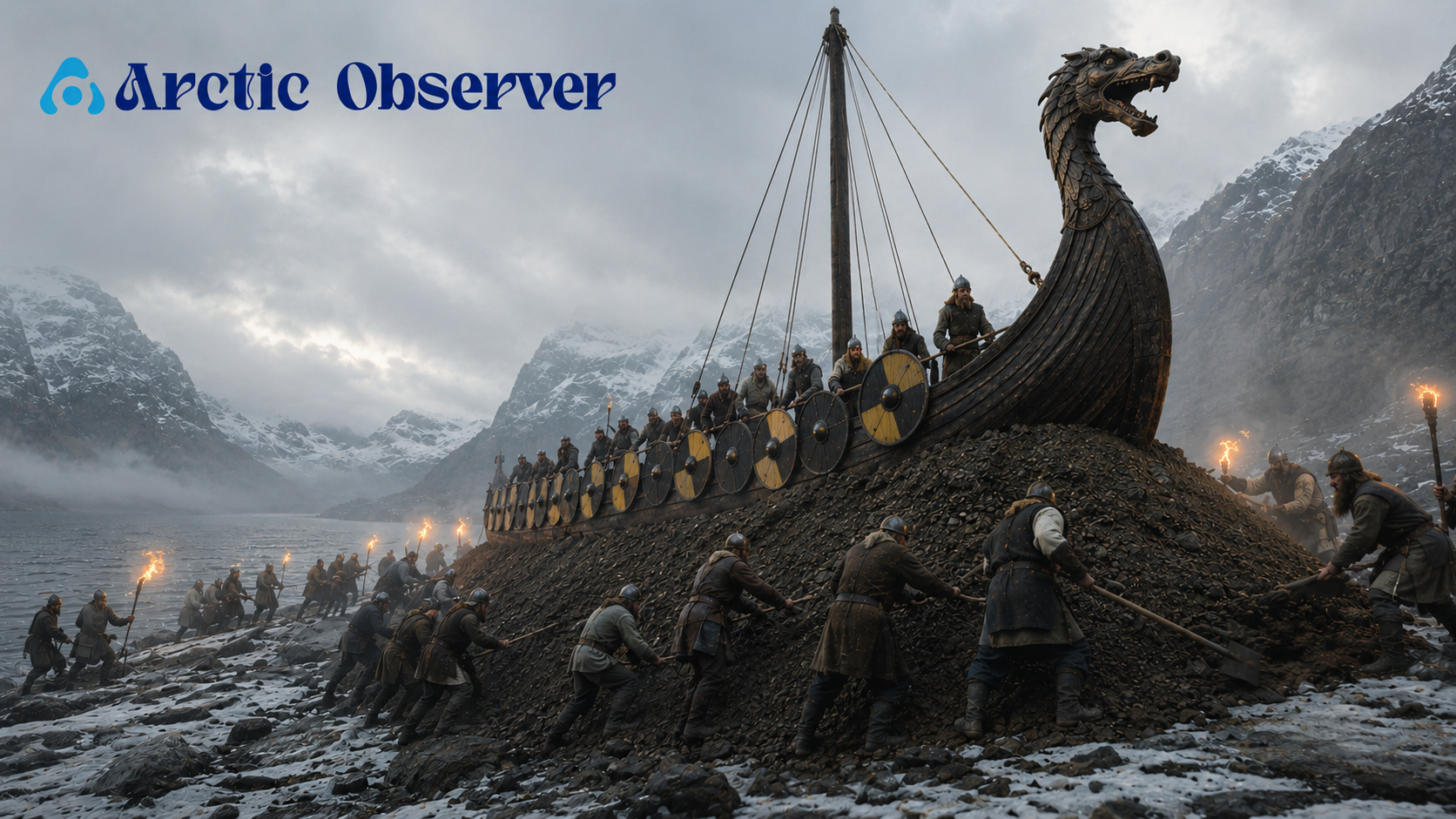
The King's Mound
With no shouts of welcome, no bonfires blazing from the cliffs and only silence greeted the weary raiders who had travelled thousands of miles to raid the Scottish coasts. Their warrior king King Olav had just died; his final farewell was to be a ship burial, so the warriors took the longship belonging to their king and placed it into a narrow fjord. There, they laid their king on his ship with his sword on top of him; his warriors provided 32 black-yellow painted warriors’ shields on both sides of the ship. The warriors then used a heavy clay and earth to build a mound to seal their king in his burial mound for his journey to Valhalla.
Over time the burial mound became just another odd-looking hill on a farm known as Gokstad; however, the Legend of the "King's Mound" has been passed down from generation to generation.
The Farmers' Discovery
Centuries passed from the Viking Age until the monumental mound at Gokstad remained—built 150 feet long and 15 feet high, long since buried and become a mere memory. In the long and frigid winter of 1880, a farmer with his sons sat around the familiar warmth of a fire like they have done for hundreds of evening fires before; the topic of the great mounted structure found on their farmland began to circulate as it always does.
"We shall excavate that mound and see if the stories hold true," declared the young men, their imagination ignited from the old tales of treasure yet to be found.
Throughout the harsh month of January the farmer and his sons chipped and dug through the hard frozen ground in order to excavate a deep pit through the centre of the mound. The young farmers worked tirelessly and only uncovered minimal remnants of the past, mainly wood. The young men could have easily ceased their efforts and claim nothing had been found, except for the fact that they had been speaking about their excavation. Word reached the town to a gold merchant and hobby archaeologist that there were archaeologists on the farm who were excavating burials which had been hidden in a mound located on the farm.
"There is much evidence of excavating and collecting at Gokstad, therefore I think it is time we have a professional to oversee the excavation," said the merchant.
He contacted Nicholas Nikolaysen, President of the Society for the Preservation of Norwegian Ancient Monuments, who arrived to immediately carry out a thorough and proper excavation of the mound containing the secrets and treasures of Norway's ancient past.
In the Well of Truth
The Gokstad ship was only one of many archaeological finds to demonstrate that history and archaeology have often overlapped in Norway, showing that the point made in old sagas were true, not just figments of the imagination.
King Sverre Sigurdsson, along with his Birkebeiner mercenaries, was attacked and defeated in his castle, Sverresborg, in a battle with his enemies, the Baglers, in *A.D.* 1197. It states in Sverre's Saga that after the fight, the Baglers burned the buildings and destroyed the castle’s fresh water supply by throwing one of King Sverre's dead men down the well, then packing it full of stones.
For centuries researchers have debated if this was a true story. However, researchers excavating the well at Sverresborg in 2014 found a human skeleton at the bottom of the well. Radiocarbon dating gave undeniable proof that this individual lived and died at the end of the 12th century, the same time as the saga stating.
“This is really astonishing!” exclaimed project leader Anna Petersén. “As far as I am aware, there has not been a case that has shown the discovery of a person who can be historically tied to an act of war that far back, nearly 1000 years.”
Resonance of the Monarch
The Viking Ship Museum located in Oslo currently houses the Gokstad ship; a lasting legacy and demonstration of the impressive architecture and workmanship from the time of the Vikings. The tale of King Olav, interred with his sword and shields inside of his ship, transitioned from a fable shared around a campfire to a real-life story discovered in Norway’s necessarily cold ground through archaeological excavation; the adventures of King Olav, once lost forever in the dark abyss, returned to life courtesy of the modified agricultural techniques used by contemporary farmers a millennium later.