Politics
Finland’s Political Parties: An Easy Guide to Understanding Finnish Politics!
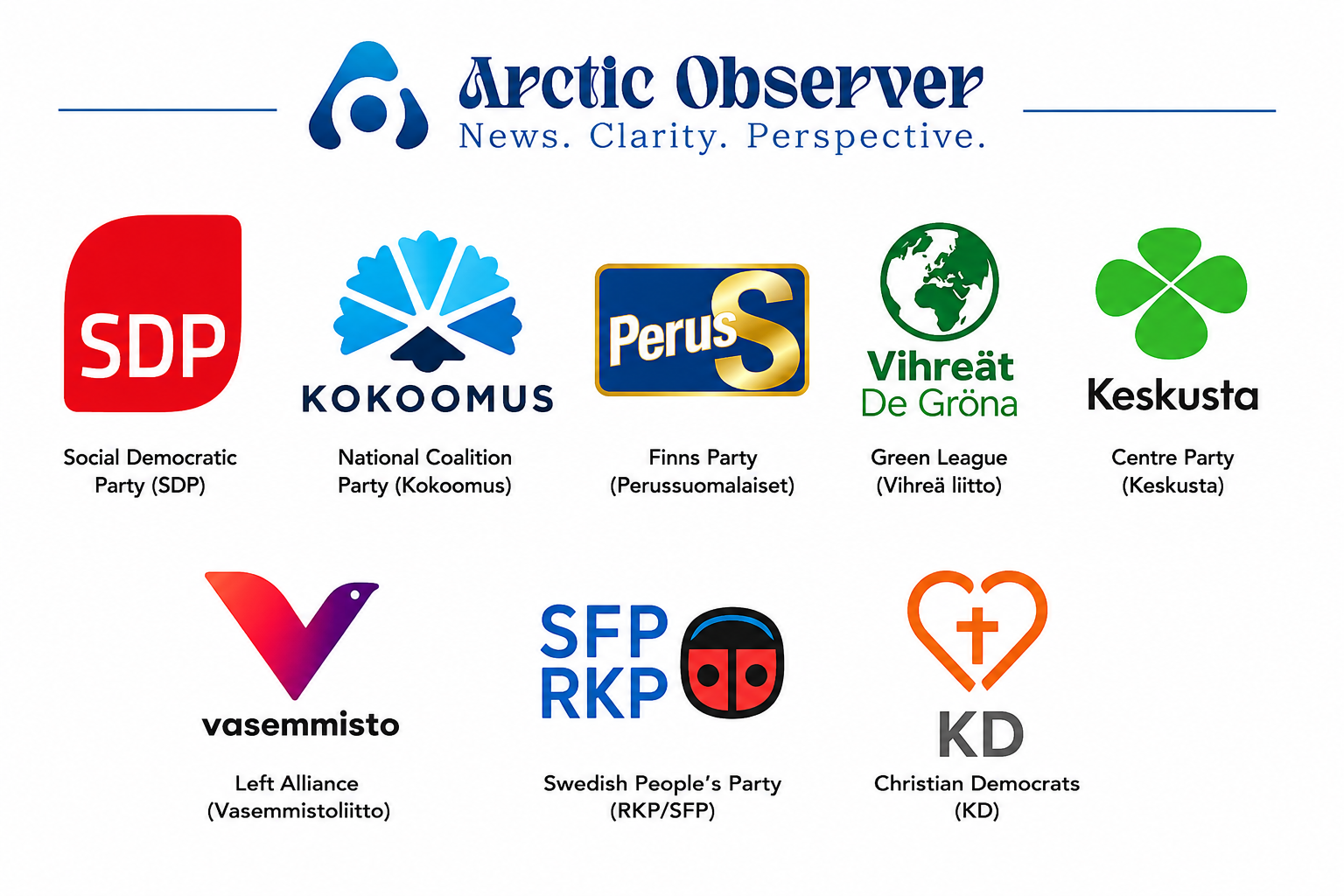
From the SDP and Kokoomus to the Finns Party and the Greens, here is a simple guide to Finland’s major political parties and what they stand for.
Finland has a multi-party-political system, which means that political power is shared among several parties rather than dominated by just two major parties.
Unlike countries where one party can often govern alone, Finnish governments are usually formed through coalition agreements. Several parties negotiate with one another and agree to work together to form a government.
This makes Finnish politics both interesting and sometimes difficult to understand especially for people who are new to the country.
One of the easiest ways to understand Finland’s political landscape is to look at how the major parties approach five important issues: the economy, welfare services, immigration, climate policy and Finland’s relationship with the European Union.
Here is a simple guide.
Social Democratic Party (SDP)
General position: Centre-left / Social democratic
The Social Democratic Party, commonly known as the SDP, has traditionally been one of the main supporters of Finland’s welfare-state model.
The party emphasizes strong public healthcare, education, social security and workers’ rights. It generally argues that economic growth should go hand in hand with social equality.
The SDP typically supports progressive taxation and an active role for government in reducing inequality and ensuring access to essential public services.
Key priorities include:
- Strong public healthcare and education
- Workers’ rights
- Social security
- Reducing economic inequality
- Investment in education and public services
- European cooperation
In simple terms:
“A strong economy should also create a fairer society.”
National Coalition Party (Kokoomus)
General position: Centre-right / Liberal-conservative
The National Coalition Party, Kokoomus, places strong emphasis on economic growth, entrepreneurship, employment and Finland’s international competitiveness.
The party generally favours policies designed to encourage businesses and employment while controlling public spending and government debt.
Kokoomus is strongly supportive of Finland’s cooperation with the European Union and has also placed considerable emphasis on national defence and security.
Key priorities include:
- Economic growth
- Entrepreneurship
- Employment
- Fiscal discipline
- Defence and security
- EU and NATO cooperation
In simple terms:
“Finland needs a strong and competitive economy to maintain its welfare state.”
Finns Party (Perussuomalaiset)
General position: National conservative / Right-wing populist
The Finns Party places particular emphasis on Finnish national interests, immigration, national sovereignty and public spending.
The party advocates stricter immigration policies and has been critical of immigration that it considers economically or socially problematic.
It also places importance on national decision-making and has questioned aspects of deeper European integration.
Key priorities include:
- Stricter immigration policies
- Stronger border controls
- National sovereignty
- Finnish identity and culture
- A critical approach to deeper EU integration
- Reducing what the party considers unnecessary public spending
In simple terms:
“Finland’s national interests should come first.”
Green League (Vihreä liitto)
General position: Green / Centre-left
The Green League, or Greens, places environmental issues at the centre of its political programme.
The party focuses particularly on climate change, biodiversity, renewable energy and sustainable development.
The Greens generally support investment in public transport and policies designed to reduce greenhouse-gas emissions. They also tend to support liberal positions on immigration, human rights and social issues.
Key priorities include:
- Climate action
- Environmental protection
- Biodiversity
- Renewable energy
- Public transport
- Human rights
- Liberal immigration policies
- Education
In simple terms:
“Finland must become greener while protecting people’s rights.”
Centre Party (Keskusta)
General position: Centre
The Centre Party has traditionally had strong support in rural Finland and smaller municipalities.
The party focuses on regional equality, agriculture, forestry and ensuring that people living outside Finland’s largest cities have access to public services and economic opportunities.
The Centre Party generally argues that Finland should develop as a whole country rather than concentrating investment and services in the largest urban areas.
Key priorities include:
- Rural areas
- Agriculture and forestry
- Regional development
- Local services
- Entrepreneurship
- Decentralisation
In simple terms:
“Finland should develop not only its cities but the whole country.”
Left Alliance (Vasemmistoliitto)
General position: Left-wing
The Left Alliance advocates a strong welfare state and greater economic equality.
The party generally supports progressive taxation, stronger workers’ rights and increased public investment in healthcare, education and social services.
It also places considerable emphasis on climate policy and social justice.
Key priorities include:
- Economic equality
- Strong welfare services
- Workers’ rights
- Public healthcare
- Education
- Climate action
In simple terms:
“Society should reduce inequality and protect those who need help most.”
Swedish People’s Party (RKP/SFP)
General position: Liberal / Centre
The Swedish People’s Party of Finland, known as RKP in Finnish and SFP in Swedish, represents the interests of Finland’s Swedish-speaking population.
However, its political agenda goes well beyond language issues.
The party strongly supports Finland’s bilingual character, liberal values, individual rights and European cooperation.
Because of its position near the political centre and its willingness to cooperate across party lines, the party has historically played an important role in several coalition governments.
Key priorities include:
- Finland’s bilingualism
- Swedish-language services
- Liberal values
- Individual rights
- European cooperation
- Education
In simple terms:
“Protect Finland’s bilingual identity while supporting liberal and European values.”
Christian Democrats (KD)
General position: Centre-right / Christian democratic
The Christian Democrats emphasise family values, social responsibility, healthcare and Christian-democratic principles.
The party supports a welfare society but also stresses personal responsibility, families and the role of communities.
Its policies often place particular emphasis on family life, children, healthcare and ethical questions.
Key priorities include:
- Families and children
- Social responsibility
- Healthcare
- Personal responsibility
- Community values
- Christian-democratic principles
In simple terms:
“A strong society is built on families, communities and responsibility.”
-Arctic Observer