Politics
Sweden’s Opposition Wins Narrow Election Majority as Prime Minister Kristersson Resigns
STOCKHOLM, September 18, 2026 —
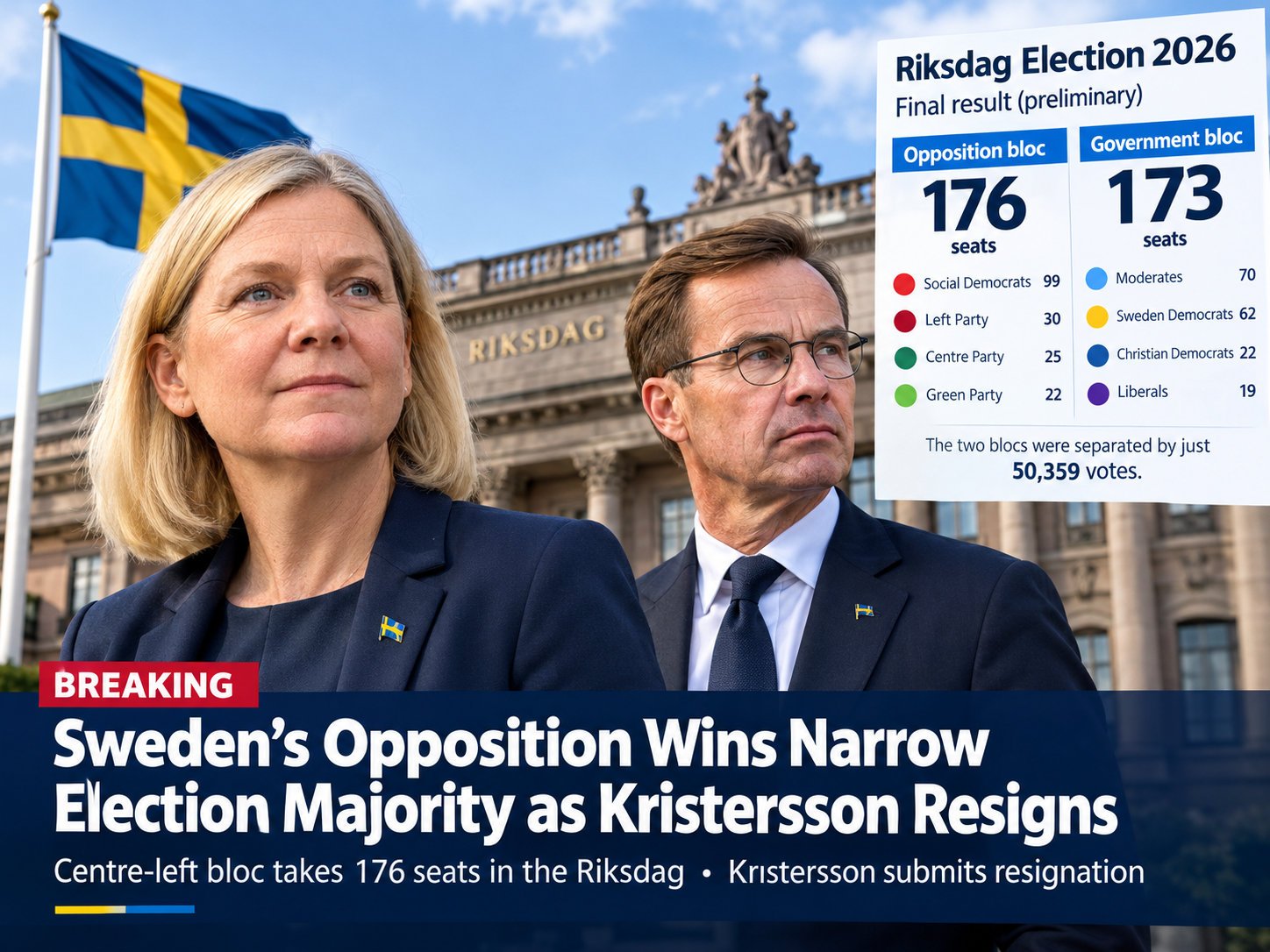
Sweden is heading towards a change of government after centre-left opposition parties secured a narrow majority in the country’s parliamentary election, winning 176 of the 349 seats in the Riksdag.
The final preliminary count, completed after several days of counting including late and overseas ballots, gave the opposition bloc a three-seat advantage over the parties supporting Prime Minister Ulf Kristersson’s outgoing government, which won 173 seats. The two blocs were separated by just 50,359 votes.
Following the result, Kristersson formally submitted his resignation to the Speaker of the Riksdag on Thursday, saying that the parliamentary speaker should now lead the process of forming a new government. His government will continue in a caretaker capacity until a successor takes office.
Social Democrats remain Sweden’s largest party
Former Prime Minister Magdalena Andersson’s Social Democratic Party emerged as the largest single party, securing 99 seats and around 28% of the vote, according to Sweden’s public broadcaster SVT.
The other parties in the opposition bloc won:
- Left Party: 30 seats
- Centre Party: 25 seats
- Green Party: 22 seats
Together, the four parties hold 176 seats in the Riksdag.
On the governing side, the Moderates won 70 seats, the Sweden Democrats 62, the Christian Democrats 22 and the Liberals 19, bringing their combined total to 173 seats.
The Sweden Democrats, which have supported Kristersson’s government from outside the cabinet, fell to third place with 62 seats, 11 fewer than in the previous parliament. The Moderates finished second with 70 seats.
Andersson faces difficult government negotiations
The election result puts Andersson in a position to attempt to return as prime minister, a post she held briefly in 2021-22. However, the 176-seat opposition majority does not automatically translate into a straightforward coalition government.
The Centre Party has opposed forming a government that includes the Left Party, while the Left Party has sought a role in the next government. Andersson has previously ruled out forming a government with the Left Party itself but has sought parliamentary support from it.
These differences could make negotiations over the composition of the next government and its budget complicated, despite the opposition bloc’s three-seat parliamentary advantage.
What happens next?
Under Sweden’s parliamentary system, the Speaker of the Riksdag will consult with party leaders before proposing a candidate for prime minister. The Riksdag must then vote on the proposed prime minister.
The newly elected parliament is scheduled to convene on September 28, when lawmakers will elect a Speaker.
The Swedish Election Authority has described the current figures as a preliminary result. The final legal result will be established after the county administrative boards complete the final count and the Election Authority formally allocates the seats and confirms the elected members.
A closely divided political landscape
The election underlines the closely divided nature of Swedish politics. The opposition’s three-seat advantage represents a narrow parliamentary margin, while only about 50,000 votes separated the two main blocs nationwide.
The result could therefore lead to a period of negotiations as the parties seek an arrangement capable of securing parliamentary support for a new government and its budget.
For now, Kristersson remains caretaker prime minister, while Andersson and the opposition parties prepare for talks over the formation of Sweden’s next government.